
There is a particular kind of self-awareness that comes with a daily commute. Standing on the Burquitlam platform, you catch your reflection in the SkyTrain window. Sitting across from a stranger for six stops, you notice yourself keeping your mouth a little closed, in photos, in meetings, in the small face-to-face moments that fill a working day. If you have ever felt that quiet pull to hide your teeth, you are far from alone.
This one is for the commuters and busy professionals around Burquitlam and Coquitlam who have thought about straightening their teeth but stalled at the same worry: the idea of a mouth full of metal at work, on the train, and in every conversation in between. The encouraging news is that modern orthodontics has changed, and straightening your smile no longer has to announce itself to everyone around you.
Why your smile feels louder on the daily commute
Commuting is one of the most face-to-face parts of modern life, even when no one says a word. You share a railcar with the same morning crowd, you sit in flat fluorescent light that hides nothing, and you are surrounded by reflective glass that keeps putting your own smile back in front of you. For anyone already a little self-conscious about crowded or crooked teeth, that combination can turn a routine ride into a low hum of self-monitoring.
It is worth naming why this matters beyond appearances. A smile you feel you have to manage shows up in small ways, a closed-mouth grin in a team photo, a hand raised when you laugh, a half-second of hesitation before speaking up in a meeting. None of these are dramatic on their own, but together they can leave you feeling a little less like yourself in exactly the settings where you most want to feel at ease. Wanting to change that is a perfectly reasonable, very human thing.
What “discreet” orthodontics actually means now
When people picture braces, they often picture the version from school hallways: a full set of metal brackets and wires, visible in every photo for years. That option still exists and still does excellent work, but it is no longer the only path. The biggest shift in adult orthodontics has been the rise of clear aligners, a treatment built specifically around being hard to notice.
Clear aligners are a series of custom-made, transparent plastic trays that fit snugly over your teeth. Each tray is shaped to move your teeth a small, planned amount, and you swap to the next tray in the series every week or two as your teeth gradually shift into place. Because the trays are thin and see-through, most people around you simply will not register that you are wearing them, which is exactly the point for someone who spends the day in close quarters with colleagues and fellow passengers.
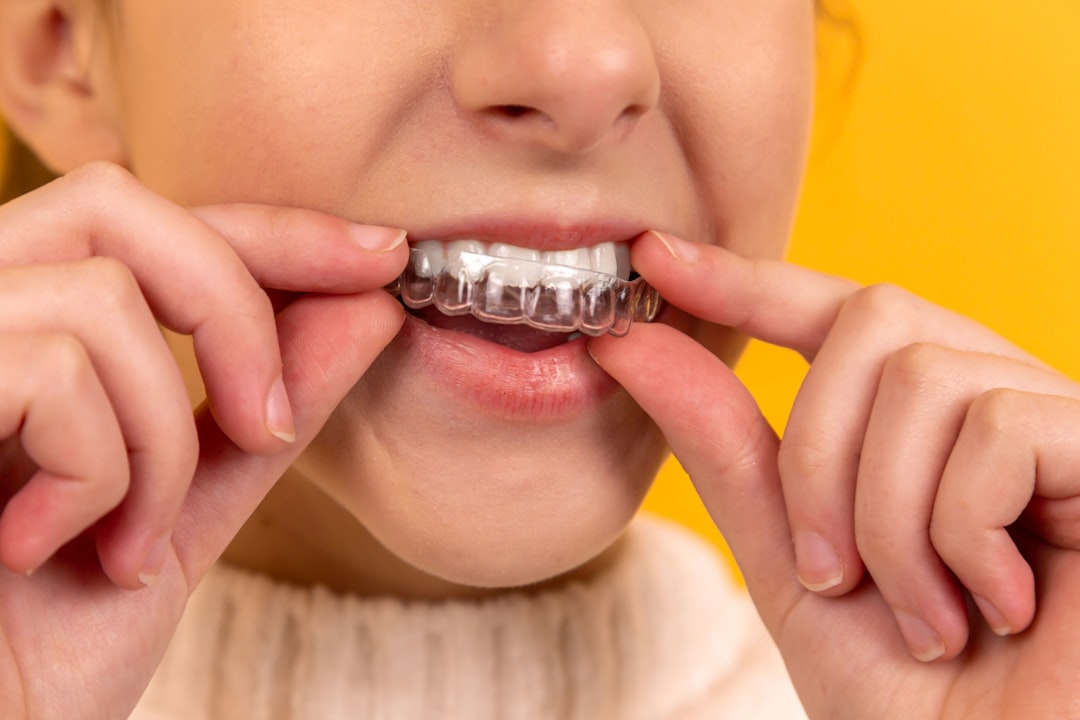
Clear aligners or traditional braces: how they differ
Discreet does not automatically mean better for every situation, and a good consultation is really about matching the method to your teeth rather than to a trend. Still, it helps to understand the basic trade-offs before you ever sit in the chair.
A few things worth weighing
- Visibility, clear aligners are designed to be near-invisible, while traditional braces use brackets and wires that show when you smile and talk.
- Removable vs. fixed, aligners come out for meals, for drinks other than water, and for brushing; braces stay on around the clock, so there is nothing to take out but also no breaks to manage.
- Daily discipline, aligners only work when you actually wear them, generally 20 to 22 hours a day, so they reward consistency and do nothing while they sit in your pocket.
- Type of correction, aligners suit mild to moderate crowding, spacing, and minor bite issues well, while more complex bite problems are sometimes better handled with braces.
- Eating and cleaning, because aligners come out, you can eat what you like and brush and floss normally; braces ask for a little more care around certain foods and cleaning near the wires.
There is no single right answer here, and the honest one depends on what your teeth actually need. For many adults with mild to moderate alignment concerns, though, the discreet route turns out to be both possible and practical.
What day-to-day life with discreet aligners looks like
One reason clear aligners suit commuters is that they fold into an ordinary routine rather than dominating it. You wear the trays through your commute, your workday, and your evening, taking them out for meals and to brush. Most people settle into a simple rhythm: aligners in for the train, out for lunch, back in afterward, with water the one drink you can keep sipping while they are on. Because there are no brackets to catch on anything and nothing visible to explain, the whole arrangement tends to stay quietly in the background of a busy day.
There is a learning curve, but it is a short one. The first day or two with a new tray can feel a little snug as your teeth adjust, which is usually a sign the aligner is doing its job. Slipping a tray in and out becomes second nature quickly, and many people find it reassuring that they can take the aligners out for a big presentation, a photo, or an important lunch and simply put them back afterward. That flexibility is part of why the approach fits so naturally around commuting and office life.
The trade-off is consistency. Aligners do their work only while they are on your teeth, so the usual guidance is to keep them in for around 20 to 22 hours a day and to treat that target seriously. Treatment length varies with how much movement your teeth need (many straightforward cases run somewhere in the range of six to eighteen months) and a dentist can give you a clearer estimate once they have looked at your specific situation. The everyday discipline is small, but it is real, and being honest with yourself about it is part of choosing well.

Exploring discreet orthodontics near Burquitlam
If any of this is nudging you toward finally asking the question, the next step is refreshingly low-pressure: a conversation. An orthodontic consultation is simply a chance to have someone look at your teeth, talk through whether clear aligners or braces would serve you better, and answer the practical questions (timing, daily routine, and what the process actually involves) before you commit to anything.
Our clinic sits in the Austin Heights neighbourhood of Coquitlam, a short hop from the Burquitlam SkyTrain station, where Dr. Lorene Lederer and our team have cared for local families for more than thirty years. We offer both traditional braces and clear aligners, and we are a multilingual, family-led practice, English, Tagalog, Hindi, Punjabi, Mandarin, Korean, and Arabic are all spoken here. You can read more about our orthodontic services or reach us through our contact page whenever you are ready to ask.
Feeling self-conscious about your teeth on a crowded train is not something you simply have to put up with, and addressing it no longer means broadcasting braces to everyone in the railcar. Discreet options like clear aligners exist precisely so that adults can straighten their smiles without rearranging how they look at work or on the commute.
If you have spent your daily ride quietly hiding your smile, consider this a gentle nudge to find out what is possible. A single consultation can tell you which approach fits your teeth and your routine, and for many people, that first conversation is the moment the whole thing stops feeling out of reach.