
You lock the classroom door at 4:30, drive home, mark a stack of assignments at the kitchen table, and fall asleep before you get through the last of them. In the morning your jaw feels tight. Not painful exactly. Tired, the way a calf muscle feels the day after a long walk up Burke Mountain.
That tiredness is worth paying attention to.
Grinding and clenching, which dentists call bruxism, happen mostly outside your awareness. A lot of it happens while you sleep. Some of it happens at 10:40 on a Tuesday while you are holding a room of twenty-eight kids together and doing the mental math on how long until the bell. Because you rarely catch yourself in the act, the first evidence usually arrives disguised as something else: a headache, a chipped edge on a front tooth, a molar that suddenly objects to cold water.
Teaching is not the only job that produces this pattern. It does combine most of the ingredients.
The signs that show up before the damage does
Most people who grind their teeth find out from someone else. A partner hears it through the wall. A hygienist points at a flat spot on a molar. If nobody has told you yet, here is what to notice on your own.
- A jaw that feels tight or heavy first thing in the morning and loosens up by recess.
- Headaches that start at the temples rather than behind the eyes.
- Teeth that have gone sensitive to cold or sweet with no obvious cavity to explain it.
- Front teeth whose biting edges look flat, or slightly see-through along the very edge.
- A click or a catch when you open wide, or a jaw that seems to hunt for its resting spot.
- Scalloped indentations along the sides of your tongue, or a firm ridge of tissue running along the inside of your cheek at the level where your teeth meet.
- Waking up less rested than the hours in bed would suggest.
One of these on its own means very little. Three or four together is a pattern.

Why the school calendar shows up in your mouth
Clenching is partly a stress response and partly a physical habit, and a school year reinforces both halves. September brings new names, new plans, new seating charts. Report card season compresses weeks of assessment into a run of late evenings. Conferences go long. Somewhere in there the coffee count climbs, the sleep shortens, and the jaw quietly takes up the slack.
There is a posture element too. Marking at a low table, leaning over a laptop on the staff room counter, holding your head forward for hours at a stretch. The muscles that close your jaw belong to the same working group as the ones running up the back of your neck, and tension in one is rarely alone.
Some medications raise the likelihood of grinding, and so do alcohol, nicotine and heavy caffeine. Interrupted breathing during sleep is another known contributor. Any of these is worth mentioning to your dentist or your family doctor, because the full picture usually explains more than any single piece of it does.
What years of grinding do to a tooth
Enamel is the hardest tissue in the human body, and it does not grow back. When two rows of teeth are pressed and dragged across each other for hours a night, the surfaces wear into flat planes instead of the rounded shapes teeth start out with. Molars lose the ridges that do the work of chewing. Front teeth get shorter. Dentin, the layer sitting under enamel, is softer and more yellow, so a worn tooth often looks darker as well as stubbier.
Wear is only part of the story. Sustained force flexes a tooth near the gumline, which can leave notched grooves there, and it puts a load on old fillings and crowns. A tooth that has already been repaired once tends to be the first to crack under that pressure. Muscles get sore. The joint in front of your ear can become irritated and stay that way.
None of this happens overnight. That is the good news, and it is also the reason the whole thing goes unnoticed for so long. Change measured in years is invisible from inside your own mouth.
What a dentist actually looks for
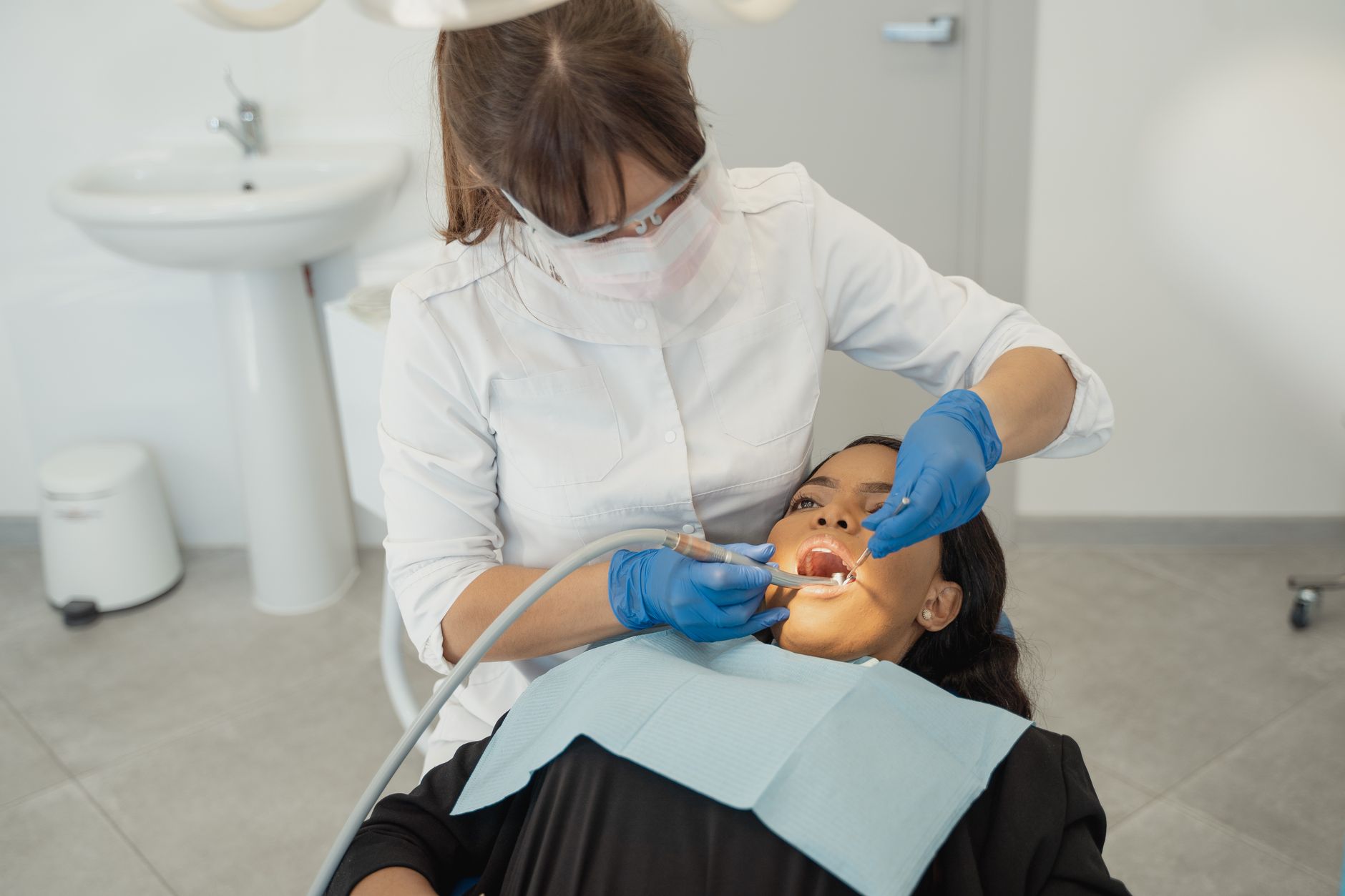
An appointment for suspected grinding is undramatic. Most of it is looking, and asking.
Your dentist compares the shape of your biting surfaces against what teeth normally look like at your stage of life. Flat facets that line up with each other when your jaw slides sideways are a recognizable fingerprint. They will check whether the wear is spread evenly or concentrated on a few teeth, look along the gumline for recession and notching, feel the muscles at your temples and under the jaw, and watch you open and close. Photos or x-rays taken this year become the baseline that next year's visit gets measured against, which is often how the pace of change gets caught.
Then come the questions. When is the jaw at its worst? Has anyone heard you at night? What does a Wednesday in November actually look like for you?
Where the pattern points to night grinding, a custom night guard is one of the common paths forward. It is made from a scan or impression of your own teeth, and the idea is that the appliance absorbs the wear in place of your enamel while giving overworked muscles something softer to press against. It does not switch off the clenching itself, and it suits some situations better than others, which is why the conversation comes before the appliance. Other approaches work on the daytime habit, on the muscles, on sleep, or on a bite that is not meeting evenly.
Things worth trying before your next visit
- Learn the neutral position: teeth apart, lips together, tongue resting on the roof of your mouth. Most people are surprised how seldom they are actually in it.
- Attach the check to something that repeats. The bell, the drive home, the first red light on Austin Avenue.
- Warmth on the jaw muscles in the evening suits some people. Gentle, never forceful.
- Ease off gum and hard candies while the jaw is sore, since chewing loads the same muscles.
- Move the last coffee of the day earlier. Sleep quality tends to show up in jaw tension the next morning.
- Keep two lines of notes a day for a week and bring them with you. Patterns you would never recall on the spot become obvious on paper.
If the pain is severe, if the jaw locks open or closed, or if a tooth has cracked or broken, that is not a wait-and-see situation. Call a dentist.
Fitting the appointment into a teacher's year
For most SD43 staff the obstacle is never interest. It is the calendar. Early mornings before the first bell, the stretch of a pro-D day, spring break and the first half of July all tend to work better than trying to carve something out of a Tuesday afternoon in November.
Dentaserv has been looking after families in Austin Heights, Burquitlam and the rest of Coquitlam for more than thirty years, a short drive from most schools in the district and close to Coquitlam Centre. If your jaw has been sore since September, that is a reasonable thing to raise at a routine exam rather than something to save for an emergency.
Educator benefit plans differ from one another and their terms change, so confirm the details of yours with your own provider rather than assuming. The visit that catches wear early is the ordinary checkup, and it is worth booking while the school year still has room in it.
A jaw that is tired every single morning is telling you something. Having it looked at is a small thing. It is a much smaller thing than a cracked molar in the middle of report cards.